
Who are St. Moses & St. Mary of Egypt?
Return, Repentance and Renewal
“I love those who love me, and those who seek me diligently will find me.” (Prov 8:17)
The church is named after St. Moses the Strong and St. Mary of Egypt, two champions of repentance who sought the faith with all seriousness.
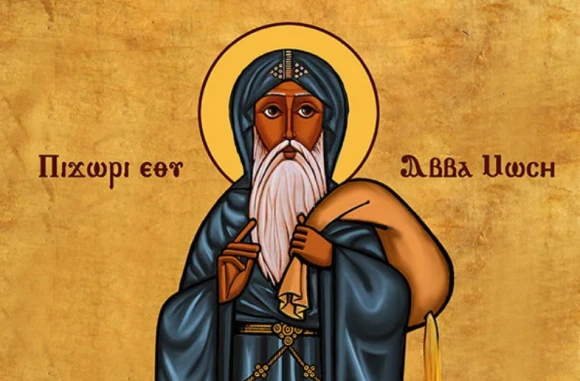
St. Moses
St. Moses the Strong lived a life of extreme sin before becoming one of the Church’s greatest saints. Once a violent bandit leader feared throughout the Nile Valley, he nevertheless cried out to the unknown God for truth. Learning that the monks of Shiheet knew the true Creator, he sought Him in the wilderness, where he embraced repentance, ascetic struggle, and a transformed life in Christ. Through humility, perseverance, and grace, St. Moses became a priest, spiritual father to hundreds of monks, and ultimately a martyr for the faith.
Read More
In his early life, St. Moses the Strong was a slave to a government official in Egypt and a worshiper of the sun. After being dismissed for theft and suspected murder, he became the leader of a gang of seventy bandits, spreading fear and violence throughout the Nile Valley. He was known for his immense physical strength and excessive indulgence in every form of evil. Yet even in his sinful life, he questioned his beliefs, lifting his eyes to the sun and saying, “O Sun, if you are God, let me know it,” and also crying out, “O God whom I do not know, let me know You.”
His life changed when he was told that the monks of Shiheet knew the true and only God. Immediately, he rose, girded his sword, and went to the wilderness of Shiheet. When he arrived at the Baramos Monastery in Wadi El-Natroun, the monks were terrified by his appearance, but St. Moses reassured them that he had come seeking the true God, the Creator.
He was received by St. Isidore the Priest, who brought him to St. Macarius the Great. St. Macarius taught him the faith of the Church, baptized him, and accepted him as a monk, guiding him in the ascetic life of the desert. St. Moses embraced severe discipline and intense spiritual warfare, greater than that fought by many saints.
The devil fought him fiercely through his former habits of excessive eating, drinking, and fornication. St. Moses revealed his struggles to St. Isidore, who guided and strengthened him. It was said that while the monks slept, St. Moses would secretly carry water from a distant well to fill their jars.
After many years of struggle, Satan struck him with a painful sore that left him bedridden. Recognizing this as a trial, St. Moses increased in prayer, humility, and worship until God healed him and blessed his endurance.
St. Moses later became the spiritual father of 500 monks and was ordained a priest. On one visit with the desert elders, St. Macarius foretold that one among them would receive the crown of martyrdom. St. Moses humbly replied, “Probably it is me, for it is written: ‘For all who take the sword shall perish by the sword.’”
Not long afterward, Barbarians attacked the monastery. St. Moses told the brethren that whoever wished to flee could do so, but he remained, saying he had awaited this day for a long time. He was martyred alongside seven brothers. One monk who had been hiding saw an angel holding a crown and came out to receive martyrdom as well.
St. Moses the Strong departed at the age of 75 on July 1 (Coptic Calendar: Baouna 24). His body now rests in the Baramos Monastery. May his blessings be with us all.
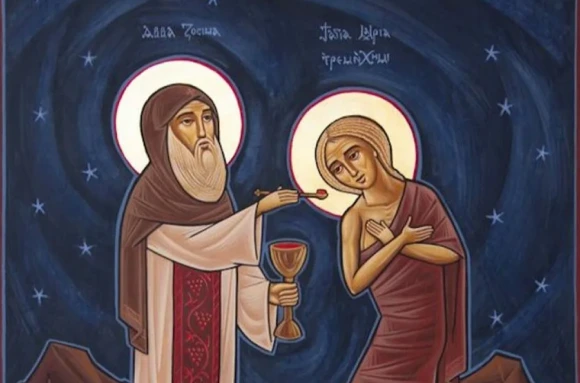
St. Mary of Egypt
St. Mary of Egypt is one of the Church’s most profound witnesses to repentance and the transforming power of God’s mercy. Though she spent many years in a life of deep sin, her spiritual encounter in Jerusalem became the turning point of her life. Through sincere repentance and the intercession of the Holy Virgin Mary, she turned wholeheartedly to Christ, renouncing her former life. She withdrew into the wilderness beyond the Jordan River, where she lived in prayer, fasting, and ascetic struggle for decades. Her life stands as a powerful testimony that no sin is beyond forgiveness and that true repentance leads to holiness, freedom, and communion with God.
Read More
St. Mary of Egypt was born in Alexandria to God-fearing parents. At the age of twelve, she was led astray by the Devil into a life of sin and harlotry, in which she remained for seventeen years. Her life changed when she traveled with a group of pilgrims to Jerusalem to celebrate the Feast of the Cross. Upon attempting to enter the church, she felt an unseen force preventing her from passing through the doors and immediately understood that this was due to her sinful life.
In deep repentance, she prayed before an icon of the Holy Virgin, asking for forgiveness and pledging to change her life. After her prayer, fear and trembling came over her, but when she returned to the church doors, she was able to enter freely and venerate the precious and life-giving Cross. Through this experience, she understood God’s mercy and His promise to receive all who truly repent.
Guided by a vision of the Theotokos, St. Mary crossed the Jordan River and withdrew into the desert, where she lived for forty years in solitude. There, she endured intense spiritual warfare and struggled against the passions she had renounced. By the grace of God, she overcame these temptations and lived a life of extreme asceticism, sustaining herself on herbs and prayer.
During one Great Lent, St. Zosimas entered the desert seeking greater devotion and encountered St. Mary. She revealed her life story to him and asked him to return the following year with the Holy Eucharist. When he returned, she partook of Holy Communion and asked him to come again the next year. Upon his return, St. Zosimas found that she had departed this life.
A lion was guarding her body, and nearby was writing that read, “Bury Mary, the poor woman, in the dust of which she was created.” The lion dug her grave, and St. Zosimas buried her and prayed over her.
St. Mary of Egypt departed at the age of seventy-six on April 14 (Coptic Calendar: Baramouda 6). Her life of profound repentance is also commemorated on the fifth Sunday of the Great Lenten Fast. Her story remains a powerful example of repentance, perseverance, and God’s boundless mercy. May her blessings and prayers be with us all.